- Overflowing gutters put water down a wall repeatedly, in the same place.
- Internal damp often appears well away from where the water is actually getting in.
- Clearing and realigning is cheap; repairing a saturated wall is not.
- Autumn and after storms are the two times worth checking.
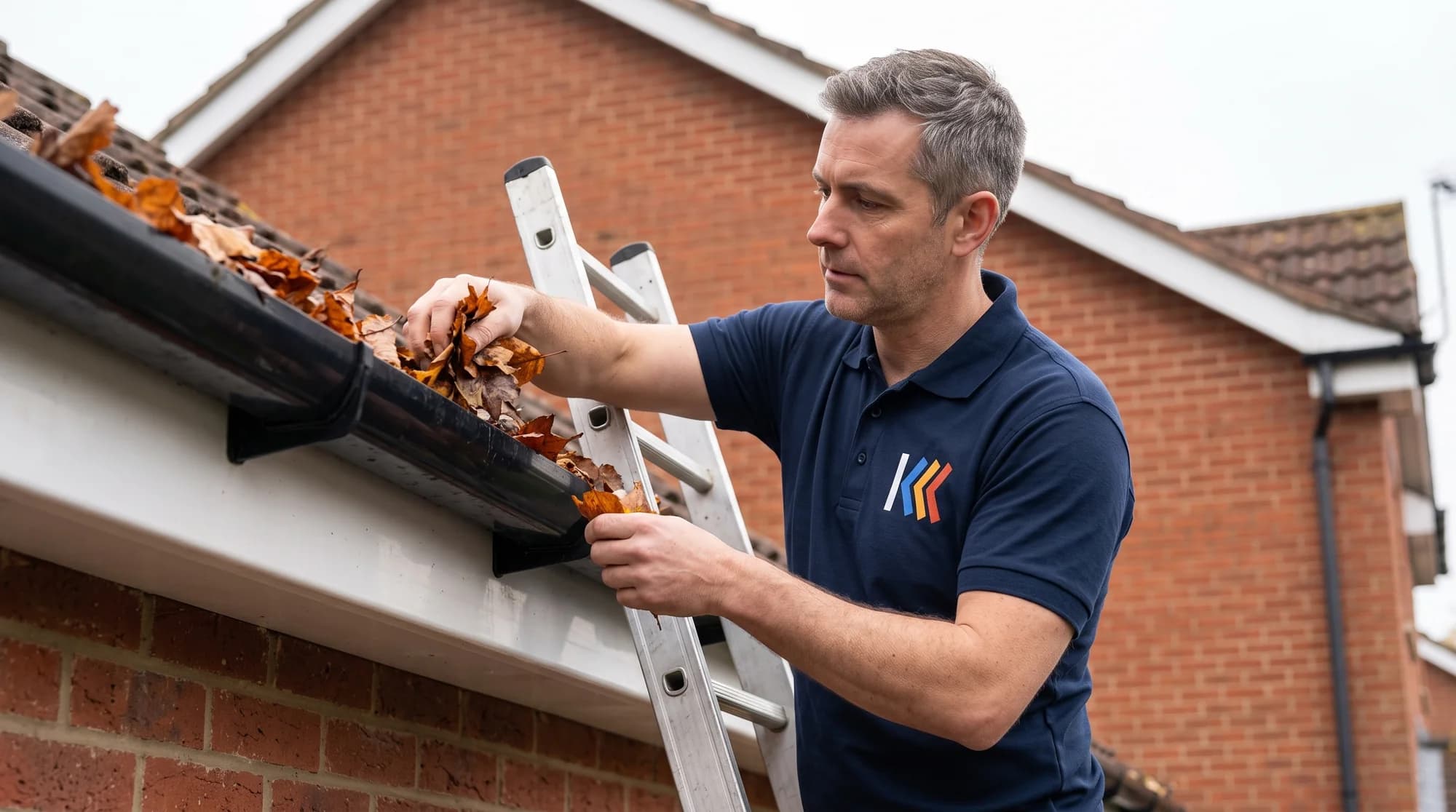
Guttering is the least interesting part of a house and one of the easiest to ignore, because when it fails nothing dramatic happens. Water simply goes over the edge instead of into the downpipe, and lands against the wall.
Do that through one winter and the wall gets a repeated soaking in exactly the same spot. Masonry that never gets a chance to dry out eventually lets moisture through, and it shows up inside as a damp patch that looks like it has nothing to do with the roof.
Why the damp appears somewhere unexpected
Water does not travel straight down through a wall. It follows mortar courses, cavity ties, and whatever route offers least resistance, which means the stain on the inside can be a metre or more from where the water actually entered.
This is why treating the visible patch rarely works. Repainting a damp wall while the gutter above it is still overflowing achieves a few months of clean paint and no more.
The usual causes, in order of how often we find them
Most guttering faults are mechanical and mundane, which is why they are usually cheap to put right if caught.
- Leaves and moss blocking the run or the downpipe outlet
- A section that has dropped, so water pools instead of running to the outlet
- Split or cracked plastic, usually where it has weathered or been frozen
- Failed joint seals between sections
- Downpipes discharging onto the ground rather than into a drain
What to look for, and when
You do not need to get on a ladder to spot most of this. The best time to look is during heavy rain, because that is when the fault is doing its work.
- Water spilling over the front edge anywhere along the run
- Streaking or staining on the wall below a joint
- Plants growing out of the gutter — a reliable sign it has been full for a while
- Damp patches inside that appear or worsen after rain
- Green algae growth on an exterior wall in a vertical stripe
Why we do this alongside heating and plumbing
It looks like an odd combination until you have seen how these jobs actually arrive. Someone calls about a damp ceiling or a stained wall, and the cause turns out to be outside the building rather than inside it.
Having one team that can look at the gutter, deal with the cause, and then put right the ceiling or the decoration it damaged means the job finishes in one go rather than waiting on another trade. Water does not respect the boundaries between trades, so it helps if the people fixing it do not have to either.
General guidance based on work we do regularly. Every property is different — if something here sounds like your situation, it is worth having it looked at rather than diagnosed from a page.